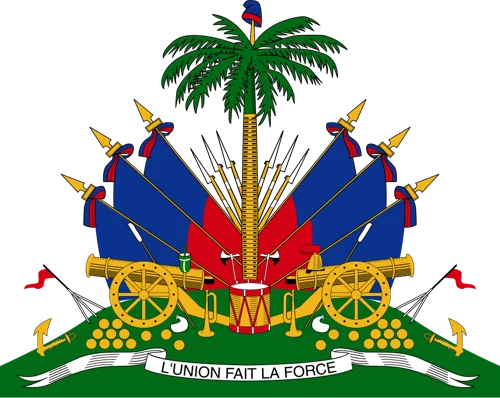
Capital: Port-au-Prince
Language: Haitian Creole, French
Currency: gourde
Haiti occupies the western part of the island of Hispaniola and shares the eastern part with the Dominican Republic. The name in the Taíno language means «mountainous land». It is the first country in the world founded by former slaves and the second independent state in the Americas after the USA.
🌿 Nature
Haiti is a mountainous country: the highest peak, Pic la Selle, is 2,680 metres. On the coast lie sandy beaches, and the mountains once held dense forests, now largely cut down. Near the town of Jacmel are the Bassin Bleu waterfalls with blue pools. Hurricanes are a feature of the climate.
📜 History
In 1492 Columbus saw the island and called it Hispaniola. First the Spaniards settled, then the French, who created a rich sugar colony on the labour of African slaves. In 1791 an uprising began under Toussaint Louverture, and on 1 January 1804 Haiti declared independence. It was the first successful slave revolt in history that created a state.
👨👩👧 People and culture
Haitians speak Haitian Creole, and French is a second official language. National art is bright paintings and metal sculptures made from drums. Compas music and the vodou religious tradition were born here. A typical dish is rice with black djon djon mushrooms.
🏛️ What to see
- The Citadelle Laferrière on a mountaintop
- Sans-Souci Palace
- The Bassin Bleu waterfalls
- Labadee beach
- The town of Jacmel
- Macaya National Park
✨ Fun facts
- Haiti is the first country created by former slaves
- The Citadelle Laferrière is the biggest fortress in the Western Hemisphere
- Haitian artists paint pictures on oil drums
- The name of the country in Taíno means «mountainous land»
- Both Catholicism and vodou are practised here
- Haiti was the first Latin American country to gain independence